|
Sent
free to subscribers to nzaawebsubscribers at yahoogroups.com
Want to be an archaeologist? -
our page
on Careers
in Archaeology will help.
More
Touring
New Zealand? - look at this page - Archaeological
Sites for the Cultural Tourist. More
Books you can buy on
line: Archaeological
Books
Send
an archaeological heritage e-card
to someone. More
|
Monday, September 29, 2003
Shackleton's Hutt In World's 100 Endangered Sites
The only building left in Antarctica by the great explorer Sir Ernest Shackleton has been identified as one of the 100 Most Endangered Sites on Earth.
The building is included in the World Monument Fund's 2004 World Monument Watch list, released in New York today. An international panel of experts selected the 100 sites on the list, considered to be the world's most imperiled historic architectural and cultural treasures. The Watch list brings the sites to international attention and helps to raise funds for their rescue.
The New Zealand Prime Minister, Helen Clark as Minister of Arts, Culture and Heritage, profiled the announcement today. The Ministry for Culture and Heritage supported the nomination and has provided core funding assistance to the Antarctic Heritage Trust, a New Zealand charity that seeks to care for the site. "
Friday, September 26, 2003
Scientists question whether humans caused extinction of mammoths
Call it North America's most mysterious mass killing. After millions of deaths, and with a chief suspect in custody, the case remains surprisingly circumstantial. (Moas broguht into the argument)
Thursday, September 11, 2003
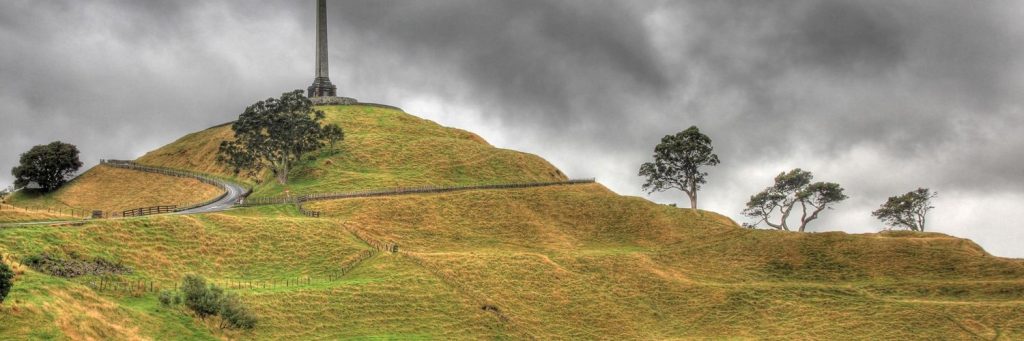
Steps to care for Mt Eden summit]
Auckland City has embarked on a major project to restore the original look of Mt Eden-Maungawhau and to improve the experience for the 1.2 million visitors who flock there each year.
The idea is to protect the natural, cultural and archaeological significance of the crater, known as Te Ipumataoho, which is an almost perfectly shaped cone.
The council also hopes to increase people's respect for the mountain and highlight the fragility of the soil, by installing educational signs."
Marsden Fund 2003 projects
Other cultural heritage projects:
Cross-cultural voyaging in the Pacific 1595-1795
The archaeology and culture history of Vella Lavella, Solomon Islands
Rediscovering the oldest-known carved Maori house (whare whakairo) and household in Aotearoa / New Zealand
The emergence of Pakeha culture: historical archaeology of the shore whalers
Bay of Islands research project
Marsden Fund project.
The fund, which supports 'curiosity-driven' research with international potential, is financed by the Government but the grants are overseen by the Royal Society, a special council within the national science academy.
Announcing the annual grants yesterday, the fund said it was paying for an iwi-based collaborative research project for the first time.
The project, initiated by Ngati Hine, will trace the history of the pre-treaty Bay of Islands by synthesising European and Maori collective histories.
It received $540,000 over three years. "
DNA shows female moa three times size of male
The mystery of New Zealand's giant moa has been solved at last - she was a female.
And the undersized specimen languishing in her shadow turns out to be a male.
Scientists have used new DNA analysis techniques to explain a size difference so great that the birds were previously thought to be two distinct species. "
Wednesday, September 10, 2003
SUMMER EMPLOYMENT OPPORTUNITY
The Auckland Regional Council Heritage Department is seeking a student to undertake cultural heritage management support tasks during the 2003 – 2004 summer vacation.
The work will primarily involve the maintenance and development of the Council’s historic places database. However it is envisaged that there will be opportunities for a suitable applicant to assist with field checking of records and other fieldwork.
Applications are welcomed from students with a background in archaeology or related cultural heritage discipline, who are computer literate, and have an interest in cultural heritage management. Some experience with Inmagic or a similar database and/or Geographic Information Systems would be an advantage. However on-site training will be provided. Previous archaeological survey experience and a current drivers license would also be an advantage.
The work will be for a period of 8 weeks duration between November 2003 and February 2004.
Applicants are to be received by 6 October 2003, and should include a current curriculum vitae. Applications or further inquiries should be addressed to:
Sarah Ross
Archaeologist
Auckland Regional Council
Private Bag 92012
Auckland
phone : +64 9 366 2000 x 8031
fax : +64 9 366 2155
e-mail : sarah.ross@arc.govt.nz
Tuesday, September 09, 2003
New life for grand old store
The 1861 Bluestone Store crouches on Durham Lane, dwarfed by rising apartment blocks and hunched beneath cranes swinging high over its rusting old roof.
After surviving more than 140 years, the oldest scoria building in central Auckland now finds itself in a new setting, at the finish of a dead-end street, jammed hard against two soaring new towers.
The sturdy but small basalt stone store has seen many owners over the years. It has been used as a nightclub, coffee bar, warehouse and storeroom, and leased to an auctioneer and a confectioner.
The store has the Historic Places Trust's highest degree of protection as a category one building.
Auckland City Council also has it listed as a significant building.
However it badly needs earthquake strengthening, re-roofing, window and door restoration and stonework repairs.
Now its owner, University Trust, which has links through Tramco Services to powerful waterfront landowner Viaduct Harbour Holdings, has applied to the council to do up the store and perhaps lease it to a restaurant.
Thursday, September 04, 2003
The Quay: New Zealand Maritime History and Diver Resources
New website:
This site is a guide to the ever growing amount of resources available to those who are researching New Zealand's maritime heritage. Many Internet archives are listed along with actual archives, such as the 'National Archive', guides and listings are given where possible. "
Wednesday, September 03, 2003
Dead end in quest for medal clues
A medal found in the mud of the Britomart site has ended up in a museum after efforts to trace details of the long-dead owner failed.
Construction worker Kevin Giddings was about to pour concrete at the new transport centre last year when he nearly stepped on what he thought was a coin lying in the mud. "
Tuesday, September 02, 2003
Harbour work queried by Historic Places Trust
The New Zealand Historic Places Trust is investigating whether the Waitaki District Council committed an offence when it undertook extensive work at the Oamaru harbour last year.
The council carried out work on the breakwater and original Macandrew Wharf. The trust had no record of authority being sought and granted as required by the provisions of the Act, the trust's southern general manager, Bruce Albiston, said.
The trust had been assured this week by the council that it would advise those responsible for further works or developments of the requirements.
Little-known iwi claims strong Waitaki affiliation
A little-known North Otago tribe has raised a dissenting voice against energy giant Meridian and its proposed Project Aqua. But what is the background of this low-profile group?
WHEN individuals representing the Waitaha iwi choose to speak out, they pick their moments carefully.
The lodging of resource consents for the Project Aqua power scheme was one such moment.
Waitaha upoko (head) Rangimarie Te Maiharoa this week said his people were deeply hurt by the proposed scheme, which would see the construction of a 60km power canal with six power stations, along the south side of the Waitaki River. Although the iwi usually kept a low profile, it had chosen to speak out now.
The iwi claims strong links with the Waitaki. Waitaha artefacts dating back more than 1000 years have been found on sites on the south side of the river."
Waitaha tribe
I WAS DISAPPOINTED to find fanciful assertions about the origins of Waitaha reported uncritically on your front page as if they were facts. The evidence from archaeology and DNA shows that New Zealand was settled by a group of at least 200 people from tropical Polynesia a little over 700 years ago. Despite the success of the Kon-Tiki expedition there is no evidence supporting migration here from South America."
Pillaging of ancient sites irks anthropologist
Unscrupulous western traders in antiquities are contributing to the pillaging of ancient cultural sites in Cambodia, anthropologist Prof Charles Higham warns.
Prof Higham, a leading University of Otago archaeologist, leaves for Thailand next month to resume work on the biggest archeological fieldwork programme undertaken in Southeast Asia.
His archaeological work is supported by a $420,000 Marsden Fund grant and traces the origins of Angkor civilisation.
Prof Higham said he had stopped digging in Cambodia because he felt 'quite sick' over the pillaging of newly uncovered sites.
Unscrupulous collectors were 'ghastly creatures' who were fuelling the pillaging and desecration of temples belonging to one of the world's greatest pre-industrial civilisations."
Digging into the old city
University of Otago anthropology student Adrian Taylor holds a mid-19th century earthenware bottle recovered from under the Farmers car park in Great King St, Dunedin, as fellow student Joanna Wylie takes notes.
Dunedin archaeologist Peter Petchey has high hopes of finding out about early life in the city during his latest dig.
Mr Petchey, assisted by a team of anthropology students from the University of Otago, is excavating under the Farmers car park in Great King St, before a $12 million redevelopment of the site takes place.
Under the Historic Places Act, the redevelopment cannot start until an archaeological investigation has been done.
Mr Petchey said the area was one of the earliest settled in Dunedin, with a plan from the 1840s showing a harbour inlet near the Farmers site.
The length of time since settlement, and undisturbed ground under the site, meant there was the potential for discoveries.
'We're hoping to find out about the nuts and bolts of early Dunedin life.'"
Monday, September 01, 2003
Conservation action
DOC annual publication 2002-03. Historic and Cultural section - pdf download.
|
Become
a Member of the N.Z. Archaeological Association
|
Members
get our quarterly magazine, Archaeology in New Zealand and discounts on publications
and events. |
|

|
This
message is intended to be compliant with New Zealand Law: The Unsolicited
Electronic Messages Act 2007. Please communicate with the webmaster on any
issues that may arise in this regard.
|
|
Opinions
in items linked in this column are not those of the Association.
An
archive of news posts can be accessed at http://www.nzarchaeology.org/blog/archive/
|