|
Sent
free to subscribers to nzaawebsubscribers at yahoogroups.com
Want to be an archaeologist? -
our page
on Careers
in Archaeology will help.
More
Touring
New Zealand? - look at this page - Archaeological
Sites for the Cultural Tourist. More
Books you can buy on
line: Archaeological
Books
Send
an archaeological heritage e-card
to someone. More
|
Tuesday, January 31, 2006
Thursday, January 26, 2006
History being lost to development Hundreds of archaeological sites nationwide are being lost to development, according to a project mapping important historic sites. A New Zealand Archaeological Association site record review will try to find thousands of Maori and European historical sites in Wellington, Kapiti, Wanganui, Wairarapa and Hawke's Bay over the next six months. But archaeologists fear many sites will have been destroyed since they were last mapped in the 1960s. The Government-funded $529,000 project has identified more than 56,000 sites for location and recording ? should they still be there. "
Wednesday, January 25, 2006
History in the Making MP Muriel Newman's web news: " New Zealand history is full of contradictions. In the very week that the government launched their $1 million road show to educate the public about the official history of New Zealand and the importance of the Treaty of Waitangi, a UK based group released a different interpretation of world history. Gavin Menzies and his 1421 Team presented new evidence of early Chinese exploration by Zheng He, strengthening their belief that Chinese colonies existed in New Zealand for hundreds of years before the arrival of Maori. While our government appears to hold tightly onto the view that Maori are tangata whenua (with even the stories of the early Moriori occupation that our generation was taught in school having almost disappeared), local and international research is now painting a different picture of the early history of New Zealand ."
Saturday, January 21, 2006
Property problems: 'Archaeological sites' protected under act By Phil Shannon and Matt Fogarty of Simpson Grierson Q. I have noticed in the media a number of instances where developers have discovered significant historical and cultural artefacts during excavation. I am interested to learn what degree of freedom developers have in such a case, what their obligations are, and what steps need to be followed. A. The Historic Places Act 1993 sets out the legal processes that apply when a person wishes to either destroy, damage or modify an archaeological site. As a person may be liable to a penalty of up to $100,000 for not complying with the act, it is imperative that property developers are fully aware of their obligations. "
Thursday, January 19, 2006
Wednesday, January 18, 2006
Gold New World The remains of a once thriving Otago Chinese settlement are the site of a major heritage development . The dig at Lawrence will provide an invaluable insight into a unique piece of Chinese-New Zealand history. Photo: Provided by Dr Richard Walter An innovative heritage development kicked off this year in Central Otago with the commencement of archaeological excavations on the site of the 19th-century Lawrence Chinese Camp. A team of archaeologists is working with the Lawrence Chinese Camp Charitable Trust on a project that will contribute towards a heritage tourism venture and increase our knowledge of New Zealand's Chinese past. "
Stone Age Footwork: Ancient human prints turn up down under Researchers working near the shore of a dried-up lake basin in southeastern Australia have taken a giant leap backward in time. They've uncovered the largest known collection of Stone Age human footprints. The 124-or-more human-foot impressions, as well as a few prints left by kangaroos and other animals, originated between 23,000 and 19,000 years ago in a then-muddy layer of silt and clay, say archaeologist Steve Webb of Australia's Bond University in Robina and his colleagues. Their report appears in the January Journal of Human Evolution. "
Hobbit may be earliest Australian THE tiny hobbit-like humans of Indonesia may have lived in Australia before they became extinct about 11,000 years ago. The startling claim comes from archaeologist Mike Morwood, leader of the team that uncovered remains of the 1m-tall hominid at Liang Bua cave on Indonesia's Flores island in 2003. They believe the pint-size person - known officially as Homo floresiensis and unofficially as the 'Hobbit' - was wiped out by a volcanic eruption that spared their Homo sapiens neighbours. "
Tuesday, January 17, 2006
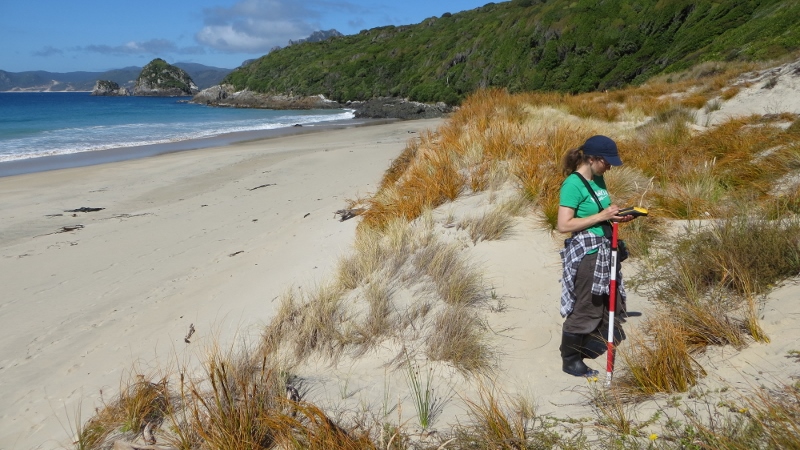
NZ firm acquires rights to map tool - Wellington-based technology company Surveylab, which last year attracted $2 million from venture capital company No. 8 Ventures, has licensed American military technology which merges a handheld computer with global positioning capability. "Things that used to take you days or weeks to generate a report are now done at the end of the day with the push of a button," said CERL researcher Tad Britt, who used one in New Orleans after Hurricane Katrina. Britt, an archaeologist, has also used it in that field. He said there was a civilian market for the system in real estate management, civil engineering and surveying. Comment: Well... and presumably archaeology?
Saturday, January 14, 2006
Ancient Maori artefact discovered on beach Three Danish tourists wandering along a deserted beach on their third day in New Zealand, spotted a piece of history lying on the shoreline. They immediately recognised that the smooth stone lying in the sand was like ancient battleaxe heads they have seen at home. Yesterday, the three men - Martin Jacobse, 19, Kristian Kappel, 19, and Kenneth Jespersen, 21 - handed their discovery, a Maori toki (adze) to the Hawke's Bay Museum. Their finding came last month after the trio, on their first day out of Auckland, drove 120km north to the remote Puketotara Peninsula on the west coast. When the road ended they then tramped through dense bush to scale a peak 'that we could see that we would like to have dinner at'. "
Thursday, January 12, 2006
A secret history of TVNZ Trevor Agenw: Who says TVNZ doesn't respond to criticism? I complained that good locally made documentaries and comedies were being screened midweek at midnight so nobody sees them. Now TVNZ has produced an eight-part series on New Zealand archaeology. Whalers, Maori warriors, a missing prime minister's corpse, cholera, Armstrong Disappearing Guns, pa sites, blazing cottages, drowned villages, earthquakes and tsunami: this new series dealt with them all! Great, you cry. When can I see it? Sorry, mate, you missed it. When did it screen? Well, where were you at 5pm on Boxing Day? Dozing in a deckchair? Bouncing on the beach? I'll bet you weren't watching TV. A pity, because TVNZ decided to screen a Kiwi archaeology series, What Lies Beneath, at 4.55pm on the eight weekdays following Christmas. Just to reinforce their opinion of the series, TVNZ screened one episode at the wrong time, so even if you had tried to record them, you wouldn't have got them all. ('Technical fault' translates as 'Nobody's watching, so who cares?') Would young viewers enjoy dramatic archaeology and interesting computer graphics bringing the past alive? Would teachers and librarians be interested in a series that examines our historic roots? Would people have set their recorders? Academic questions because few knew about it. The minimal publicity for What Lies Beneath was overwhelmed by the Christmas deluge. "
Electronic Publications New electronic publication - Tony Walton - 2006 - Site survey reports held in the Central File of the site recording scheme.
Monday, January 09, 2006
NZ Journal of Archaeology - Latest edition - Vol 26 David Harrowfield: Archaeology on ice Fiona Petchey, Roger Green, Martin Jones, Matthew Phelan: Local marine correction for Watom Patrick Nunn, Sepeti Matararabe, Tomo Ishimura, Roselyn Kumar, Elia Nakoro: Lapita-era geography in northern Fiji. Marianne Turner: Variation among early NZ adzes. Kevin Jones: Pa, forest and fire in the western Urewera Ranges"
Sunday, January 08, 2006
Iron Age 'bog bodies' unveiled Archaeologists have unveiled two Iron Age 'bog bodies' which were found in the Republic of Ireland. The bodies, which are both male and have been dated to more than 2,000 years ago, probably belong to the victims of a ritual sacrifice. In common with other bog bodies, they show signs of having been tortured before their deaths.
Sunday, January 01, 2006
Ancient humans brought bottle gourds to the Americas from Asia Plants widely used as containers arrived, already domesticated, some 10,000 years ago Thick-skinned bottle gourds widely used as containers by prehistoric peoples were likely brought to the Americas some 10,000 years ago by individuals who arrived from Asia, according to a new genetic comparison of modern bottle gourds with gourds found at archaeological sites in the Western Hemisphere. The finding solves a longstanding archaeological enigma by explaining how a domesticated variant of a species native to Africa ended up millennia ago in places as far removed as modern-day Florida, Kentucky, Mexico and Peru. The work, by a team of anthropologists and biologists from Harvard University, the Smithsonian Institution's National Museum of Natural History, Massey University in New Zealand and the University of Maine, appears this week on the web site of the Proceedings of the National Academy of Sciences. Integrating genetics and archaeology, the researchers assembled a collection of ancient remnants of bottle gourds from across the Americas. They then identified key genetic markers from the DNA of both the ancient gourds and their modern counterparts in Asia and Africa before comparing the plants' genetic make-up to determine the origins of the New World gourds. " (This story has appeared before - but this is a more coherent account)
Skulls shed new light on migration to Americas Cranial shapes hint at two separate waves of settlers, scientists say For decades it has been believed that the first peoples to populate North and South America crossed over from Siberia by way of the Bering Strait on a land-ice bridge. However, a new study examining the largest collection of South American skulls ever assembled suggests that a different population may have crossed the bridge to the New World 3,000 years before those Siberians. Scientists occasionally discover skulls in South America that look more like those belonging to indigenous Australians and Melanesians than Northern Asians, but researchers tend to regard these skulls as anomalies due to natural variation rather than a norm, mainly because there were too few to study.
Desecration of Iwi sites in Wellington angers local tribes. Archaeological evidence of local Iwi dwellings in the heart of the wellington CBD about to be destroyed by insensitive pakeha developers. On the corner of Taranaki and Manners street In Wellington, a large ancient Pa with three or more ancient dwellings dating probably to the 6Th and 7Th century or even later, were unearthed recently by developers on a half acre piece of real estate said local Iwi scientist Karena Puhi. This half acre site would provide for local Iwi a clear picture of the lives Iwi lived in the environs of the Te Whanga Nui A Tara area, one of its original names in pre-pakeha days. The developers are today or very soon going to cover this site with a high rise apartment block, which would destroy any hope of Iwi carrying out an extensive archaeological examination of the site for the next 100 to 200 years. We could find out who was there, what the area was used for, by whom, when and for how long also who was there before the Kupe. "
|
Become
a Member of the N.Z. Archaeological Association
|
Members
get our quarterly magazine, Archaeology in New Zealand and discounts on publications
and events. |
|

|
This
message is intended to be compliant with New Zealand Law: The Unsolicited
Electronic Messages Act 2007. Please communicate with the webmaster on any
issues that may arise in this regard.
|
Opinions
in items linked in this column are not those of the Association.
An
archive of news posts can be accessed at http://www.nzarchaeology.org/blog/archive/
|
|