|
Sent
free to subscribers to nzaawebsubscribers at yahoogroups.com
RSS link for this
news:
Explorator
Science
Daily - Archaeology
About
- archaeology
Stone
Pages Archaeo News
Google
News - archaeology
A
Blog About History
 Digital
Site Record Scheme
www.archsite.org.nz
The
New Zealand archaeological Wiki.
archaeopedia.com
Want to be an archaeologist? -
our page on Careers
in Archaeology will help.
More
Touring
New Zealand? - look at this page - Archaeological
Sites for the Cultural Tourist. More
|
Saturday, September 27, 2008
Friday, September 26, 2008
Scientists out to solve puzzle of Easter Island's collapse - 26 Sep 2008 - NZ Herald: New Zealand National news "A New Zealand-led group of scientists plan to try to solve the mystery of the sudden collapse of the population on Easter Island in pre-European times. The group, led by environmental scientist Troy Baisden of GNS Science and plant ecologist Mark Horrocks of Microfossil Research, want to test a hypothesis the Easter Island population "over-shot" the carrying capacity of their aged and weathered volcanic soils." Er - what sudden collapse was that? It is denied by some.
Marsden: 2007 results Was collapse inevitable on Easter Island (Rapa Nui): reconstructing a civilisation's failure Dr WT Baisden Dr M Horrocks The Polynesian iconoclasm In the first half of the 19th century, a series of remarkable events took place in eastern Polynesia. People in islands as distant as Hawaii, Rarotonga, and Tahiti destroyed their marae and temples. The question is, why? The easy answer is simply because they had all become Christian, but Professor Sissons from Victoria University believes that this is not the whole solution. Thanks to a Marsden grant, he intends to investigate further and write a book, provisionally titled ‘The Polynesian Iconoclasm’. The project will describe and interpret, for the first time as a single phenomenon, the widespread destruction of religious images and architecture that accompanied the introduction of Christianity into eastern Polynesia. Individual events on some of the islands have been described before, but never those in the region as a whole. Local politics are likely to have had a significant role in the events of the iconoclasm, which were orchestrated by local chiefs. While the majority of these were directly linked to Christian conversion, this was not always the case. The destruction of temples in Hawaii in 1819 occurred before any missionary had arrived there and the destruction of marae and images in Rarotonga in 1824 was directed by high chiefs seeking to bring about greater political centralisation. Even where European missionaries were present, iconoclastic episodes were always the outcome of convergences between missionary and local chiefly projects. One aim of this research is to gain a better understanding of the diversity of these chiefly projects and their convergences with those of missionaries. To place the Polynesian iconoclasm in context, Associate Professor Sissons also intends to compare it with similar events in other times of social upheaval such as the Reformation in Europe, thus emphasising its world-historical significance. Researcher: Professor Jeff Sissons School of Social and Cultural Studies, Victoria University of Wellington
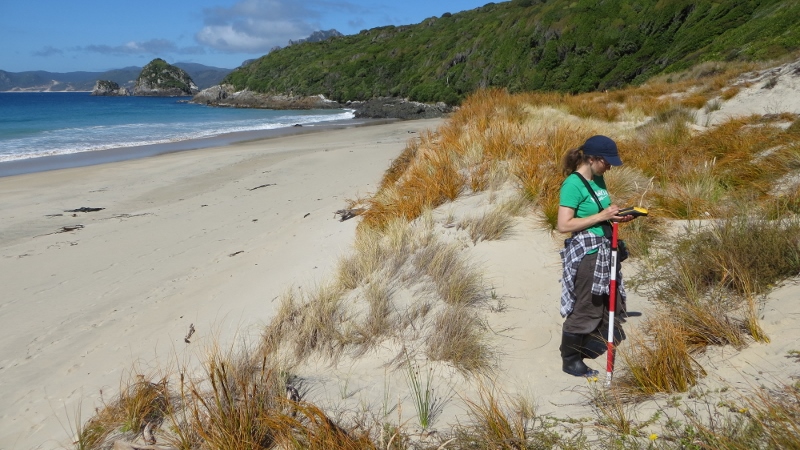
Robert Brassey writes Summer Employment OpportunityThe Auckland Regional Council Heritage Team is seeking a competent archaeologist to undertake a field survey of priority areas of coastline in the Auckland region during the summer of 2008 ? 2009. The work will involve:?Field survey to record archaeological sites and other heritage places in the coastal environment;?Preparation of site record forms, entering these into the Council?s historic places database and submitting completed archaeological site records to the NZAA site record file;?Iwi consultation as required.The contract is expected to involve 6-7 weeks work in total between November 2008 and February 2009. A student will be available for at least part of this period to provide assistance with fieldwork and data entry. We are looking for a qualified and experienced archaeologist able to work without supervision. A current driver?s license and NZ Residency are necessary.For further inquiries phone: (09) 366 2000 ext 8101or email heritage@arc.govt.nz
Wednesday, September 24, 2008
DSc for David Harrowfield "Antarctic historian, geographer and Oamaru resident David Harrowfield has recieved a Doctor of Science in recogntion of his work as the White Continent's first systematic archaeologist and for his scientific work in relation to wind and sediment transport and timber weathering."
Tuesday, September 23, 2008
Malcolm Hutchinson, Gentleman Adventurer The link I had last week about 'How I became an Archaeologist' I now find (thanks Malcolm) part of a whole site. Spot the stories on the Lawrence Chinese Camp and the Wellington Bypass
Monday, September 22, 2008
Saturday, September 20, 2008
Auckland Heritage Festival Auckland Heritage Festival 2008 programme 20 September - 5 October 2008 Around Auckland city The programme
Thursday, September 18, 2008
Main Page - Mt Eden Gaol History Wiki History of the Mt Eden Gaol (and the later Prisons) This website is designed for those working on the renovations to the Mt Eden Prison in Auckland to track the background and progress of archaeological and historical research on the site.
Wednesday, September 17, 2008
Tuesday, September 16, 2008
Saturday, September 13, 2008
AUCKLAND UNIVERSITY PRESS
Mother's Gift Fuel;s Lifelong Passion As David Veart left home for the first time in the early 1970’s, his mother presented him with the essential Edmonds Cookery Book and a lifelong passion for cookbooks was born. Since that gift from his mother, David Veart has accumulated a library of over 500 cookbooks and, along the way, has developed a devotion for recipes and cooking; shortly, he will become a published food historian First Catch Your Weka: A Story of New Zealand Cooking by David Veart Published by Auckland University Press illus; $49.99 Trained as an anthropologist, he works as a Department of Conservation historian and archaeologist. He has an MA from The University of Auckland, belongs to the Auckland Heritage Committee of the Institute of Professional Engineers and is an expert on Mangere Mountain, North Head and the islands of the Hauraki Gulf. He has been best known to date for his public guided walks of these areas, particularly, North Head and Motutapu Island, about which he has also written film scripts and narrated interpretative films.
Friday, September 12, 2008
Thursday, September 11, 2008
Okere Falls: Meet the Locals videos Okere Falls Watch this video to find out how Okere Falls touches many people in different ways. This Bay of Plenty hot-spot has something for everyone!"
Molesworth Station: Meet the Locals videos Molesworth Station Welcome to Molesworth Station. Watch this video to find out more about this historic station in the Nelson/Marlborough area."
Golden Point Battery: Meet the Locals videos Golden Point Battery Golden Point Historic Reserve Video Otago Nic visits Golden Point Battery in Otago, one of New Zealand's oldest gold mining operations. Check out how DOC rangers fire up the old engine every year!"
Mokoia Island: Meet the Locals videos Mokoia Island Mokoia Island is an culturally significant site, steeped in history. Watch this video to find out about Rotorua's history, and some of the species recovery work DOC does here."
Waikato Conservation Week activities and events 2008 "Walk in Karangahake Gorge Join Forest and Bird on a walk in the Karangahake Gorge exploring the historic relics and tunnels of the gold mining days. Date: Sunday 14 September Time: 10am Venue/meeting place: Meet at Karangahake car park opposite the Talisman Café on State Highway 2. Important information for attendees: Bring your lunch, raincoat, strong footwear and a torch. More information and contact: Maureen Cawley +64 7 889 3968."
Wednesday, September 10, 2008
Monday, September 08, 2008
New Zealand Archaeology NZ Journal of Archaeology - Latest edition - Vol 29: Roger Green and Martin Jones - Age of Lapita sites, Solomon Islands Kelvin Day - Hawera Pa Phil Moore - Oven stones Western Bay of Plenty Craig Scott - Obsidian exchange in NZ David Addison and others - Village site, American Samoa Kevin Jones - Shotover River gold mining.
Sunday, September 07, 2008
Another Google Earth ghost town - Millerton - West Coast.

Saturday, September 06, 2008
Meri Low writes:Hi everyone. PDC would like to invite "expressions of interest" for the next workshop (description below). Please email me at your earliest convenience if you wish to reserve a place. meri.low@xtra.co.nz Cheers Meri Low PDC Admin Support PDC Workshop on Remote Sensing, or You see what you know: Non-intrusive methods as the initial phase of an archaeological project Auckland (Venue to be confirmed) 14 November 2008, 9.00 am to 4.30 pm (approx.) This workshop will describe a number of modern non-intrusive remote sensing techniques that are being used in New Zealand. These are especially valuable when transformed into multiple overlays, and can provide an important tool for archaeological assessment or preparation for intrusive investigation. The techniques to be discussed include: Coordinating historic maps and plans, information from survey field notebooks, contour maps and digital elevation models (DEM) Aerial photos including, time layered aerials photography, geo-referencing oblique aerial photography and infra red photography Geophysical techniques including, ground penetrating radar (GPR), soil resistivity, soil conductivity and geomagnetic Overlaying all forms of information using computer assisted design (CAD) and geographic information systems (GIS) The workshop will also discuss how this form of preparation can greatly assist the initial assessment stage and guide the later intrusive investigations. It also has the ability to better provide for the preservation of representative sites or parts of sites. Feedback from the workshop will assist the presenters to prepare their papers for publication, address those questions that the delegates have, and enable the expansion of this type of archaeological investigation in New Zealand. The workshop will be led by Caroline Phillips and Hans-Dieter Bader, in association with Allen Juffermanns, Ian Lawlor, Dan McCurdy and Daniel Parker, and with contributions from Matt Watson. Programme outline: Introduction: Caroline Phillips & Hans-Dieter Bader Overlaying/georegistration: Allen Juffermanns Time layered aerials: Caroline Phillips Oblique aerials: Ian Lawlor (or Dan McCurdy) Digital elevation model: Daniel Parker Geomagnetics: Hans -Dieter Bader (with comments from Matt Watson) CAD/GIS: Daniel Parker & Dan McCurdy Conclusion: Hans/Caroline Q & A session. All participants.
Te Puna - A New Zealand Mission Station Angela Middleton Te Puna - A New Zealand Mission Station Springer: Series: Contributions To Global Historical Archaeology October 2008
Thursday, September 04, 2008
Election 08 Art and Culture Policies - Major Parties Update: 04/09/2008 Links to the party websites. Will be updated from time to time.
Tuesday, September 02, 2008
Monday, September 01, 2008
Landfall On 31 August Roger Green celebrated the 50th anniversary of his arrival in New Zealand, with a group of friends and the traditional cake. Thanks to Katty Prickett for the pic.

|
Become
a Member of the N.Z. Archaeological Association
|
Members
get our quarterly magazine, Archaeology in New Zealand and discounts on publications
and events. |
|

|
This
message is intended to be compliant with New Zealand Law: The Unsolicited
Electronic Messages Act 2007. Please communicate with the webmaster on any
issues that may arise in this regard.
|
Opinions
in items linked in this column are not those of the Association.
An
archive of news posts can be accessed at http://www.nzarchaeology.org/blog/archive/
|
|